Right Care, Right Time: Using an Acuity Tool to Guide Visit Frequency in Home-Based Palliative Care

Home-based palliative care teams are increasingly asked to do more with less. As programs grow, clinicians care for people living with serious illness who have complex symptoms, psychosocial stressors, and rapidly changing needs—often with team bandwidth stretched to the limit. One of the most persistent operational challenges is deciding how often patients should be seen and by whom, especially when acuity fluctuates week to week.
Without a standardized approach, decisions about visit frequency can feel subjective, inconsistent, or reactive. Teams may unintentionally over-serve patients who are stable while underserving those at the highest risk of crisis and hospitalization. Our home-based palliative care program encountered this challenge firsthand, which prompted us to develop and study a practical acuity tool designed specifically for home-based care.
Why Visit Frequency is So Hard in Home-Based Palliative Care
Unlike clinic-based care, home-based palliative care lacks predictable schedules or uniform patient trajectories. A patient may appear clinically stable one visit and experience rapid decline the next. At the same time, staffing constraints require teams to make daily prioritization decisions that carry real consequences for patients, caregivers, and clinicians.
While several palliative care frameworks address symptom burden and care intensity, few tools are designed to help outpatient teams objectively determine visit cadence or proactively identify patients at highest risk for hospitalization. What our program was missing was a structured, practical way to align clinical need with limited resources—without relying solely on individual judgment.
Building on Existing CAPC Tools and Taking the Next Step
In developing our acuity tool, we were intentional about not starting from scratch. We began by reviewing existing CAPC resources already familiar to many palliative care programs, including ProHealth’s Disenrollment Protocol and the stepwise acuity framework developed by Sean Reed.
These tools provided an essential foundation. They emphasize thoughtful triage, symptom burden, and aligning services with patient need, principles that strongly resonated with our team. They also helped conceptualize how patients move along a continuum of need and how services should adapt accordingly.
However, as our program expanded, we identified a persistent gap. While these frameworks were clinically helpful, they were largely descriptive rather than predictive. They did not provide a standardized way to quantify acuity or consistently distinguish patients who were stable from those at highest risk for hospitalization.
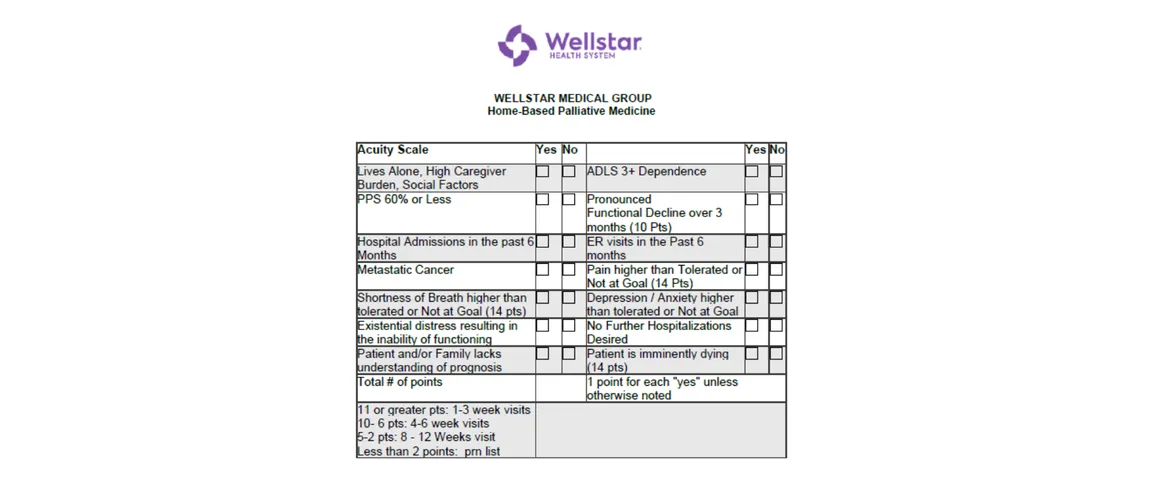
To address this, we adapted these concepts into a numerically weighted scoring grid that integrates both symptom burden and patient-specific clinical characteristics. Each criterion was assigned a point value, producing an overall acuity score that could be applied consistently across clinicians and disciplines. Importantly, we then tested this approach.
Our research demonstrated that higher acuity scores were statistically significant predictors of 30-day hospital admission following a home-based palliative care visit. Moving from a qualitative framework to a quantitative model allowed us not only to guide visit frequency, but to do so using a tool that was measurable, reproducible, and evidence informed.
What the Tool Changed in Our Day-to-Day Practice
Implementing the acuity tool shifted our team from reactive to proactive care.
Instead of asking, “Who hasn’t been seen recently?” we began asking, “Who is at highest risk right now?”
The tool helped us:
- Standardize visit frequency decisions across providers
- Match patients with the appropriate team member (APP, nurse, or social worker)
- Identify patients who needed earlier follow-up after symptom changes or care transitions
- Support equitable allocation of limited provider time
Equally important, the tool reduced cognitive burden for clinicians by providing a shared framework for decision-making in an otherwise unpredictable care environment.
What Other Palliative Care Programs Can Apply Now
Programs do not need to replicate our tool exactly to benefit from these principles. The key is adopting a structured approach to acuity that reflects your patient population, staffing model, and scope of services.
Looking Ahead
Create a shared definition of acuity. Identify which symptom, functional, and psychosocial factors signal higher need in your setting.
- Use acuity to guide visit cadence. Let patient need—not habit or availability alone—determine follow-up frequency.
- Align team roles to acuity. Ensure patients with the highest scores receive timely interdisciplinary support.
- Reassess regularly. Acuity is dynamic; tools should support ongoing reassessment rather than static categorization.
- Use data to support staffing decisions. Structured acuity data can strengthen the case for program growth and resource allocation.
Looking Ahead
Home-based palliative care will continue to expand, and pressure on teams will only increase. As programs grow, intentional, data-informed approaches to care delivery are essential to prevent crisis-driven care and clinician burnout.
Our experience suggests that a thoughtfully designed acuity tool, grounded in existing CAPC frameworks and strengthened through quantitative validation, can help teams deliver the right care, at the right time, to the people who need it most. We hope sharing this approach encourages other palliative care programs to adapt and refine tools that support sustainable, patient-centered home-based care.

Be the first to read articles from the field (and beyond), access new resources, and register for upcoming events.
Subscribe