The Beating Heart of Palliative Care Teams: Four Key Findings from the 2026 Palliative Pulse Survey
Earlier this year, CAPC launched the third annual Palliative Pulse survey, which is our opportunity to hear directly from palliative care professionals across the country. In it, we ask how they are doing and what CAPC can do to help improve their practice and well-being. Throughout February and March 2026, more than 650 participants completed the survey. While not a representative sample, the results provide valuable insight into our field’s professional needs, which CAPC will use to develop new resources and educational content.
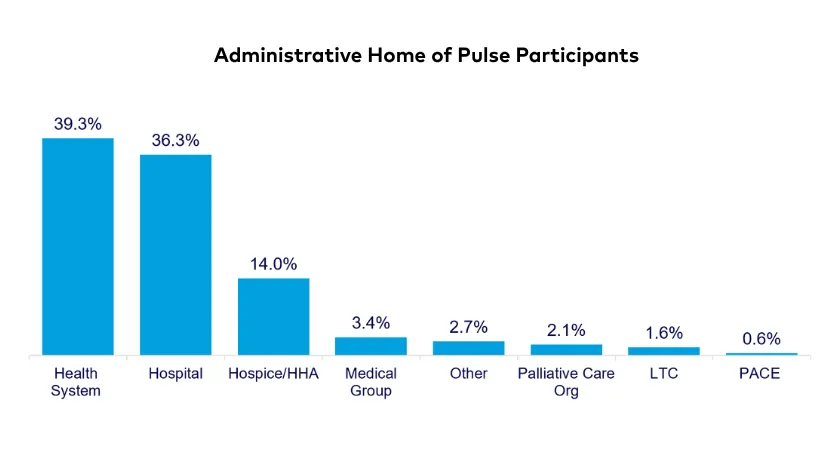
In total, 677 palliative care professionals participated in the survey. About one-third (39.3%) worked for palliative care teams operated by health systems, another third (36.3%) for teams operated by hospitals, and the remainder worked for a mix of hospices, home health agencies, physician groups, and other organizations. Participants reported that their teams provided palliative care in all settings, with more than three-quarters (79.2%) providing care in the hospital.
All U.S. regions were represented, including Puerto Rico, with the largest proportion of responses from the South (31.5%). Additionally, all patient age groups were represented, including one-quarter (24.8%) reporting that their teams treat children with serious illnesses.
Key Findings from the 2026 Palliative Pulse Survey
Note: All key findings are based on self-report
1. The emotional well-being of palliative care team members remains a top concern
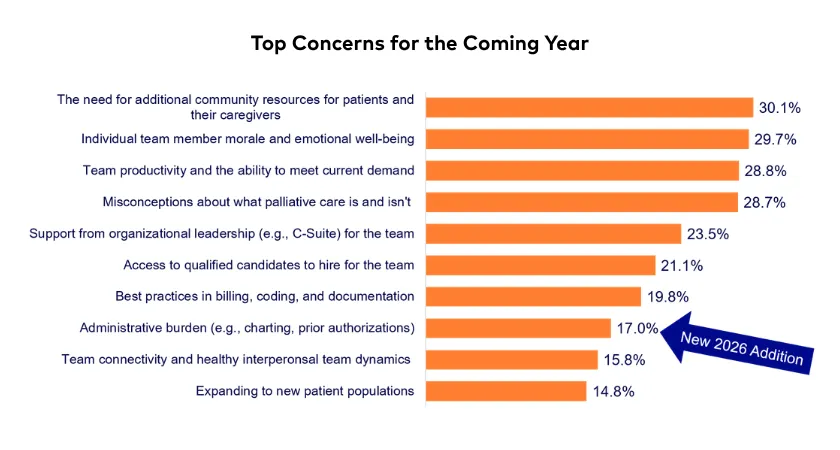
For the third year in a row, “individual team member morale and emotional well-being” was one of the top concerns for respondents. Nearly 30% of participants selected it as one of their top three concerns, which aligns with data from the previous two years.
The only “top concern” that increased in proportion since 2025 was the “need for additional community resources for patients and caregivers” with 30.1%. Among those who self-identified as team leaders (n=236), the top most-reported concerns were team productivity (37.3%), emotional well-being (29.7%), and billing and coding best practices (28.4%).
"How do you take time to refill before you pour out again in this work?”
2. Clinical skills training is a top priority
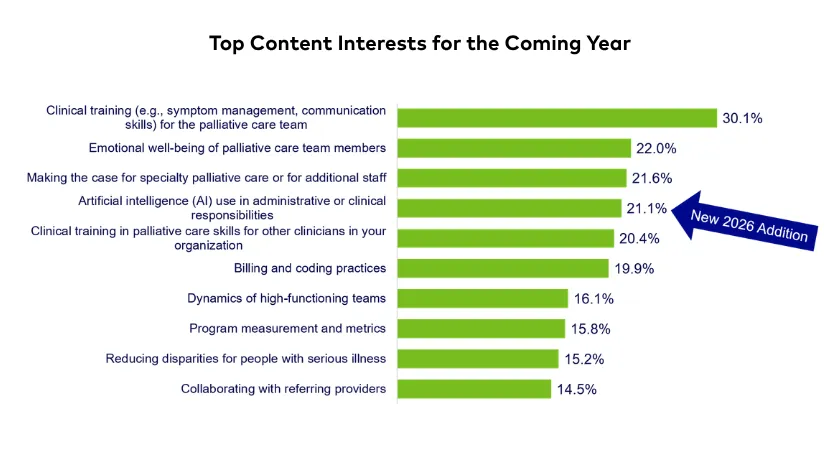
In 2024, 2025, and 2026, Pulse participants reported that clinical skills training was a top area of interest for future CAPC content. To better understand our respondents’ goals for clinical training, starting in 2025 we offered two more specific answer options: both “clinical training for the palliative care team” (30.1%) and “clinical training in palliative care skills for other clinicians in the organization” (20.4%) were top choices. Respondents’ wish lists for CAPC resources also included “emotional well-being” (22.0%) and “making the case for specialty palliative care” (21.6%).
A new answer option for 2026, “artificial intelligence (AI) use in administrative or clinical responsibilities,” was selected as a top area of interest by 21.1% of respondents. For the subset of respondents who are palliative care team leaders, top selections were “billing and coding practices” (30.5%), program measurement (26.3%), and artificial intelligence (25.4%).
3. Consult volumes continue to climb without a corresponding increase in team staffing
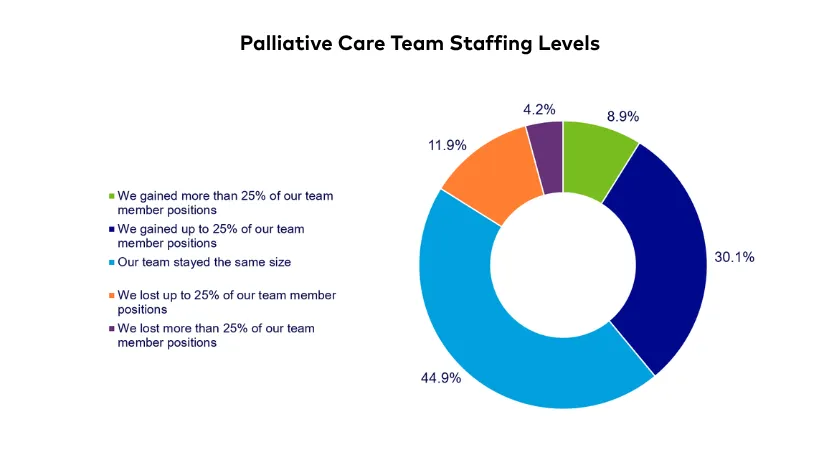
Almost three-quarters (73.7%) of participants reported an increase in consult volumes since last year (26.7% said they were much higher than the previous year). At the same time, only 39.0% of team leaders reported an increase in their team’s staffing levels. Almost half (44.9%) reported no change in staffing. This aligns with productivity being a top concern: palliative care teams are tasked with increasing consult volumes without corresponding staffing increases necessary to provide quality care and safeguard team member well-being.
4. Perceptions of palliative care program sustainability and value have remained largely consistent
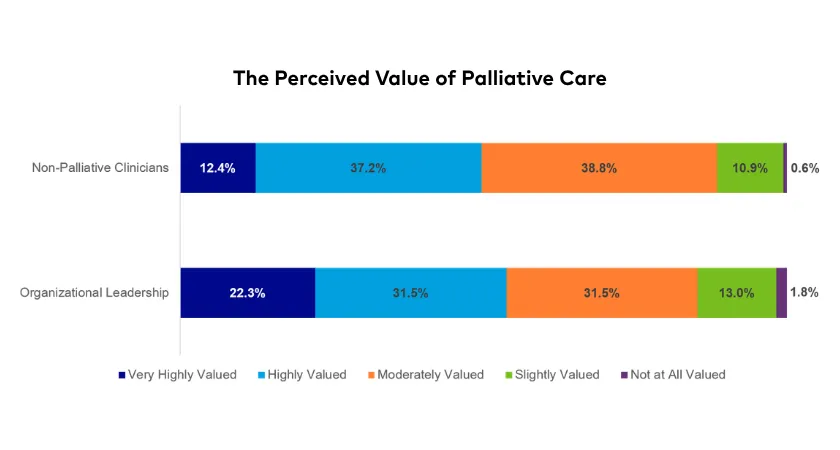
A little less than one-third (30.5%) of team leaders had high levels of concern about the future sustainability of their programs (compared to 33.7% in 2025), and only 8.9% of respondents felt no concern. Similarly, there was little change in the proportion of respondents who felt that organizational leadership (2026=53.8%, 2025=54.2%) and non-palliative care clinicians (2026=49.6%, 2025=49.3%) highly value the specialty service.
"[I'm most proud] when I leave a room knowing that I've made a difference.”
Conclusion
The CAPC team is grateful to everyone who took the time to complete the Palliative Pulse survey this year. It is an invaluable opportunity for us to gain insight from our key constituents. Your preferences are being considered as we plan future educational content, including the programming for the CAPC National Seminar in 2027. We can’t wait to see you in Columbus next year and hope you will consider sharing your thoughts with us again when the 2027 Palliative Pulse survey launches.

Be the first to read articles from the field (and beyond), access new resources, and register for upcoming events.
Subscribe