Center to Advance Palliative Care

Sign Up for Email Alerts!
Get CAPC news
and updates.

For Patients and Families
Partner
Sponsor
 
  Print this page

Do Hybrids Save Money? A Nurse Practitioner/Hospitalist Model for Inpatient Palliative Care Consultation in an Academic/Community Hospital

Jason Morrow, MD, PhD Send Email
Carlye Carr, MSN, FNP, BC
Duke University Health System
Durham Regional Hospital
<< previous next>>
(Click on poster to view full image in pop up window)

Durham Regional Hospital Institution/Program Description

Durham Regional Hospital (DRH) is a 369-bed, community hospital that has deep roots in the Durham community and has been a part of the Duke University Health System since 1998. The Department of Hospital Medicine began in 1996 and has grown into a robust service staffed by 18 full-time and 4 part-time physicians (some of whom have faculty appointments), one Physician Assistant, and one Nurse Practitioner. In 2006, an inpatient Palliative Care Consultation Service was created within the Department of Nursing, staffed by a sole Nurse Practitioner. In 2007, in an effort to improve access to palliative care across departments and to improve reimbursement practices, the Nurse Practitioner joined the Department of Hospital Medicine. Since that time, the model for the consultation service has been a hybrid of Nurse Practitioner and Physician services. The service has also relied on the guidance and academic resources of our sister program, the Center for Palliative Care at Duke University Hospital.

Description of Topic

The purpose of the consultation service is to improve the quality of life and dying for as many patients and their families as possible, while at the same time remaining financially solvent by providing cost savings to the hospital. To that end, we have attempted to draw on the experiences of a seasoned Palliative Care Nurse Practitioner and the skills of Hospitalist Physicians who are committed to end-of-life care and can provide medical supervision. We are also collecting operational data as part of a business proposal designed to secure broad and long-term support from hospital leadership. We are making a financial case for the survival and growth of our service.

Impact on Program

Our program has maintained a privacy-protected spreadsheet on all palliative care consultations since June 2006, including diagnosis and reason for consult, dates of admission, consultation, and discharge, as well as length of stay and disposition. We consulted an analyst within DRH Performance Services to help identify variable, direct costs (including physician and therapist services, as well as surgery, cardiology, radiology and pharmacy services) associated with patients who had received a consultation. Our goal was to expose differences in variable, direct costs before and after the day of palliative care consultation and compare this to a DRG-matched comparison group who had not received a consultation. We selected a before-and-after point of 2/3 through length of stay for the comparison group because the average day of palliative care consultation was 2/3 through length of stay.

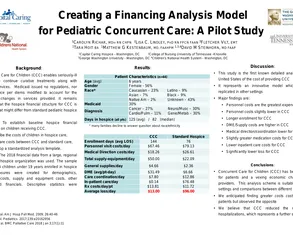
We evaluated 193 patients who met inclusion criteria. We found a significantly greater reduction in variable, direct costs for patients who received a palliative care consultation (using a t-test; p < 0.0001). We found a 31% reduction in cost per day (about $280) for patients in the palliative care group, as opposed to an 18% reduction (about $163) in the comparison group. Our consultation service therefore reduced daily costs by an additional 72% ($117 per day).

Lessons Learned

Opportunities for growth in our program can build on the opportunity for cost savings. Our analysis reveals that the frequency of consultation doubled from about 12 to 24 consultations per month from June 2006 to February 2008. This suggests that our program has been perceived as useful to other clinical services. In order to ensure continued growth, we hope to maintain the invigorating relationships between Nurse Practitioner and Hospitalist and between the Community and Academic legacies of DRH. With additional support, we hope to increase the availability and visibility of the consultation service through in-service education for nurses and therapists, skills-training for Hospitalists who can participate in consultations, and collaboration with the Palliative Care Fellowship Program at Duke University Hospital.

<< previous next>>